
Overview
Unlocking the power of bottom-up simulation to understand complex social and economic systems.
Why This Course Is a Must-Have for Forward-Thinking Professionals
Traditional models often look at the world from the top down, using average behaviors and aggregate equations to describe systems. But in the real world—especially when dealing with people, markets, and organizations—the “average” rarely tells the whole story.
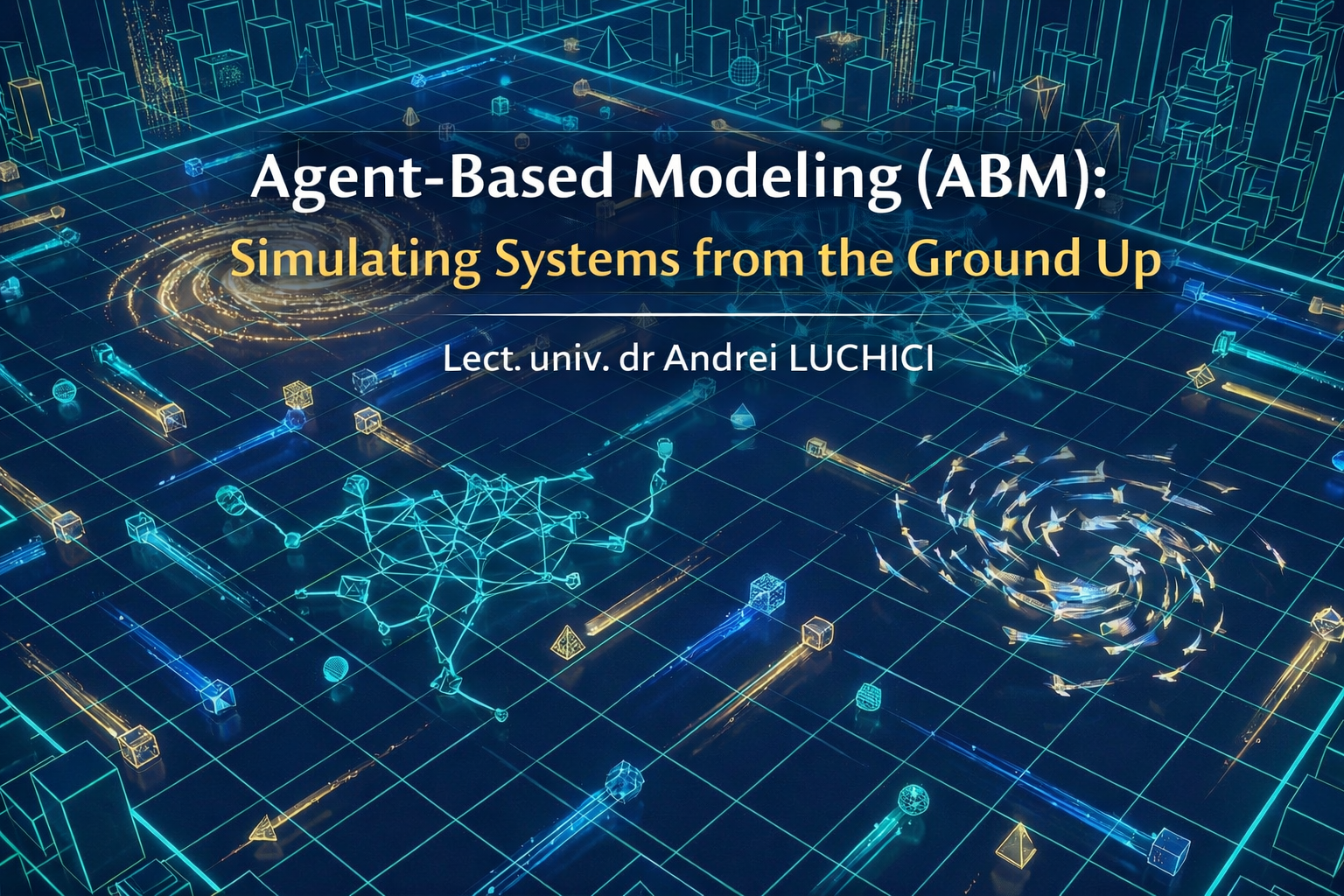
Agent-Based Modeling (ABM) is more than just a simulation technique—it’s a paradigm shift. Instead of forcing systems into rigid equations, ABM allows you to model individual entities (agents), specify their unique behaviors, and watch as complex, emergent patterns unfold in real-time.
Designed for students and professionals in business, finance, and social sciences, this practical course teaches you how to grow macro-level insights from micro-level rules. You will learn to move beyond traditional “equation-based” thinking and start building “digital twins” of organizations and markets.
You’ll learn to:
- Think Bottom-Up: Shift from system-level variables to individual decision-making entities.
- Model Heterogeneity: Move beyond the “average consumer” to represent the unique differences that drive real-world outcomes.
- Study Emergence: See how simple local rules generate complicated global patterns, from bird flocking to market crashes.
- Explore “What-If” Scenarios: Use simulation as a strategic tool to probe organizational changes or market interventions without real-world risk.
- Navigate the Challenges: Spot “snake oil” concerns, validate models with macro-level data, and use machine learning to let agents learn from their environment.
🚀 Why invest in this course? Because complex systems are non-linear and unpredictable. Whether you are designing a more efficient evacuation plan, optimizing traffic flow, or predicting financial market disparities, ABM gives you the tools and mindset to simulate the future—today.
🤝 No complex differential equations required. Just a new way to see and simulate the world.
🎯 Learning Goals
By the end of the course, participants will:
- Understand the three core components of ABMs: Agents, Environments, and Interactions.
- Distinguish between Equation-Based Modeling (EBM) and Agent-Based Modeling (ABM).
- Identify real-world use cases in traffic design, evacuation dynamics, and financial markets.
- Learn how to use the Python to implement models and run simulations.
- Grasp how to calibrate and validate models using experimental data and machine learning.
Curriculum
Section 1: Foundations of Agent-Based Modeling
- 1.1 Introduction to Bottom-Up Modeling
- 1.2 The Three Pillars: Agents, Environment, and Interactions
- 1.3 Emergent Behavior: From Flocking Birds to Social Segregation
Section 2: ABM vs. Traditional Approaches
- 2.1 Top-Down (EBM) vs. Bottom-Up (ABM)
- 2.2 Moving Beyond Averages: The Power of Heterogeneity
Section 3: Applications in Business & Finance
- 3.1 Simulating Markets: Tick Sizes and Price Disparities
- 3.2 Risk Management: Digital Twins of Organizations
Section 4: Technical Implementation
- 4.1 Building your first simulation with the Mesa library
- 4.2 Defining Rules and Random Activation
Section 5: Challenges & Future Trends
- 5.1 Validation, Calibration, and Data Mining Rules
- 5.2 Integrating Machine Learning: Letting Agents Learn
Course Features
- Lectures 2
- Quiz 0
- Duration 10 weeks
- Skill level All levels
- Language English
- Students 0
- Certificate No
- Assessments Yes
Curriculum
- 1 Section
- 2 Lessons
- 10 Weeks
- Video Course with Presentation and Sample2
Instructor

You May Like

Search Engine Optimization (SEO): On-Page, Off-Page and Semantic Web Strategies
Understanding how search engines discover, interpret, and rank web content is essential in today’s digital ecosystem. This course provides a practical and structured introduction to...
From Search Engine Optimization to Generative Engine Optimization
The digital visibility landscape is rapidly evolving. Traditional Search Engine Optimization (SEO) is no longer the final destination — modern web platforms must now adapt...

IT for Business – Hands-on Intro to MS Excel
This course offers a practical, step-by-step introduction to Microsoft Excel, designed for beginners who want to quickly build essential skills for academic and business use....


An Introduction to Etiquette and Protocol. On manners, attitude and know-how
Etiquette and protocol are the foundational structures of human interaction, designed to foster respect, efficiency, and harmony in social and professional environments. While often used...
Essential communication in protocol and skills for business etiquette
Do you want to know the unwritten rules and formal procedures that govern professional behavior, essential for building trust, respect, and successful business relationships? While...